
SEO for Ecommerce: Complete Step-by-Step Guide [2026]
Ecommerce SEO is the practice of improving an online store’s organic search visibility across product pages, category pages, and content assets. It combines technical work (site architecture, crawl control, schema markup), on-page optimization (titles, descriptions, copy), and off-page signals (links, brand mentions) to drive qualified buyers from search engines to checkout.
Organic search drives roughly 33% of traffic to ecommerce sites, more than any other channel, yet most online stores publish thousands of product URLs without a coherent SEO strategy. The result is wasted crawl budget, duplicate content cannibalization, and category pages that should rank but barely register. This guide covers what actually moves the needle.
Ecommerce SEO is not the same as blog SEO. The page types are different, the duplicate content risks are larger, and the technical surface area is broader. A store with 5,000 SKUs and faceted filters can generate hundreds of thousands of crawlable URLs, most of which add zero value to search engines. Getting that under control is half the battle.
What Is Ecommerce SEO?
Ecommerce SEO is the process of optimizing an online store so that product pages, category pages, and supporting content rank in organic search results for queries with commercial intent. It covers three layers that work together.
The technical layer concerns how search engines crawl, render, and index the storefront. Site architecture, URL structure, faceted navigation handling, JavaScript rendering, and Core Web Vitals all fit here. The on-page layer covers what each URL communicates: title tags, meta descriptions, headings, body copy, structured data, and internal links. The off-page layer covers trust signals: backlinks, brand mentions, reviews, and the authority signals that compound over time.
For stores built on JavaScript-heavy frameworks, rendering becomes its own discipline. Teams working with React SEO, Next.js SEO, Angular SEO, or Vue SEO need to confirm that Googlebot receives fully rendered HTML, not a thin shell awaiting hydration. Server-side rendering or static generation is non-negotiable for most ecommerce contexts.
Ecommerce SEO vs. Regular SEO: Key Differences
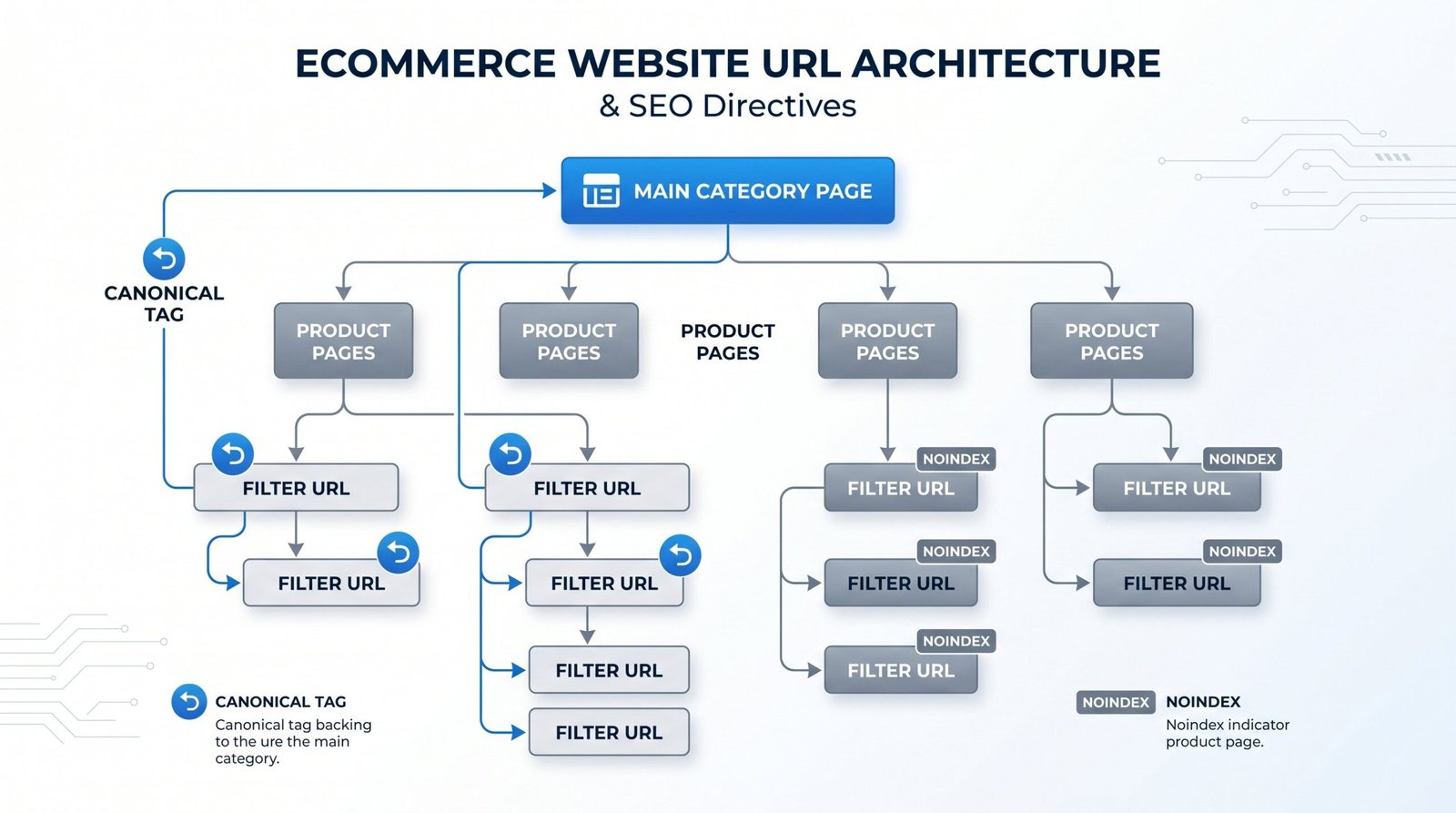
The mechanics overlap, but the scale and stakes diverge sharply. The table below shows where the practices part ways.
| Factor | Ecommerce SEO | Standard Blog SEO |
|---|---|---|
| Page types | Product pages, category pages, brand pages, filter pages, checkout-adjacent pages | Articles, landing pages, pillar pages, author pages |
| Duplicate content risk | High, driven by faceted navigation, variant SKUs, sort orders, and pagination | Low, mostly limited to tag pages or syndication |
| Schema markup | Product, Offer, AggregateRating, BreadcrumbList, Review | Article, FAQPage, HowTo, BreadcrumbList |
| Conversion goals | Add to cart, purchase, average order value | Email signup, ad impressions, affiliate clicks |
| Keyword types | Transactional and commercial (buy, best, price, review) | Informational and navigational (how, what, why) |
| Content volume | Thousands of templated product URLs plus a small content hub | Hundreds of unique long-form articles |
The differences cascade. Because a store has thousands of similar URLs, indexation control matters more than raw content production. Because keywords skew transactional, search intent mapping has to align with funnel stage rather than topical depth alone. Approaches that work for SEO for SaaS or SEO for web apps share technical fundamentals with ecommerce but rarely face the same combinatorial URL explosion.
Technical SEO for Ecommerce Sites
Technical SEO is the foundation. If Googlebot cannot crawl, render, or correctly index the storefront, no amount of copywriting will save it. The three areas below cause the most damage when neglected.
Site Architecture and URL Structure
A flat architecture keeps every important page within three clicks of the homepage. The pattern is Home, then Category, then Product. Deeper hierarchies bury equity, slow crawl discovery, and frustrate users. If a store has subcategories, they should sit as children of categories, not as a fourth tier under brand pages or filter combinations.
URL slugs should be short, lowercase, hyphenated, and human-readable. The slug should describe what the page is about without relying on database IDs or session parameters. Compare these two URLs:
- Bad:
example.com/p?id=83472&cat=14&session=xyz - Good:
example.com/running-shoes/nike-pegasus-41/
The clean version communicates topic and hierarchy at a glance, supports breadcrumb generation, and survives platform migrations more gracefully.
Silo structure groups related content within a clear topical boundary. Running shoes link to other running shoes, road running content links to trail running content, and the entire running silo connects upward through a single hub category. Cross-silo links should be intentional, not accidental. Internal anchor text should describe the destination, not say “click here.”
Handling Faceted Navigation and Duplicate Content
Faceted navigation is where most ecommerce sites quietly bleed authority. A category like “running shoes” might offer filters for size, color, brand, price range, and material. With five filters and four values each, a single base URL can spawn over 600 unique parameter combinations, most of which produce thin, near-duplicate pages. Multiply that across hundreds of categories and the crawl problem is obvious.
The problem has four overlapping symptoms. First, Googlebot wastes crawl budget on URLs that will never rank. Second, duplicate content signals split ranking authority across many variants. Third, low-value URLs get indexed and drag down site quality scores. Fourth, internal PageRank flows leak into parameter URLs that have no business existing in the index.
The fix is a layered approach. No single tactic covers every case, and the wrong combination can compound the damage.
Solution 1: Canonical tags. Every filtered URL should declare a canonical tag pointing to the unfiltered base category. If a user visits /running-shoes/?color=blue&size=10, the page’s <link rel="canonical"> should point to /running-shoes/. Canonicals are hints, not directives, but Google respects them in most cases when the content is genuinely similar. They consolidate ranking signals back to the page meant to rank.
Solution 2: Noindex meta robots on filtered pages. For filter combinations that should never rank, add <meta name="robots" content="noindex, follow"> to the page head. The follow directive preserves link equity flow through the page even as it stays out of the index. Use noindex on parameter-driven filter pages, sort orders, and pagination beyond page one when those pages add no unique value.
Solution 3: Google Search Console URL Parameters tool. Note that Google deprecated the legacy URL Parameters tool in 2022. The replacement workflow is to use canonical tags and noindex directives as primary signals, and to monitor indexing behavior through the Pages report in GSC. The Pages report exposes which URL patterns Google is indexing, which it is excluding, and which it has crawled but not indexed. Treat this report as the source of truth for whether your canonical and noindex signals are landing.
Solution 4: Robots.txt disallow for parameter patterns. For parameters that should never be crawled, a robots.txt rule blocks Googlebot from ever requesting those URLs. A common pattern looks like this:
User-agent: *
Disallow: /*?sort=
Disallow: /*?session=
Disallow: /*?utm_
One caution: robots.txt disallow blocks crawling, not indexing. If those URLs have external links pointing to them, they can still appear in search results as URL-only listings. For complete removal, combine robots.txt with noindex applied while the URLs are still crawlable, then add the disallow once Google has dropped them.
The sequencing matters. If a page is blocked by robots.txt, Googlebot cannot see the noindex tag, so the page can linger in the index forever. Apply noindex first, confirm the URLs are gone, then optionally tighten with robots.txt.
Page Speed and Core Web Vitals
Core Web Vitals measure real user experience and feed directly into Google’s ranking systems. Three metrics matter most. Largest Contentful Paint (LCP) tracks how long the main content takes to render, with a target under 2.5 seconds. Cumulative Layout Shift (CLS) measures visual stability during load, with a target under 0.1. Interaction to Next Paint (INP), which replaced First Input Delay in 2024, measures responsiveness to user interactions, with a target under 200 milliseconds. Google’s Core Web Vitals documentation covers the measurement methodology in detail.
For ecommerce, the conversion impact is sharper than the ranking impact. A one-second delay in LCP can cut conversion rates by 7% or more on mobile. Product page hero images, third-party scripts, and unoptimized CSS are the usual culprits. Image weight is almost always the first thing to fix.
Practical actions include serving images as WebP or AVIF, preloading the LCP image, deferring non-critical JavaScript, eliminating render-blocking resources, and reserving space for images with explicit width and height attributes to prevent layout shift. Third-party tags (analytics, A/B testing, chat widgets) often add 200 to 800 milliseconds of blocking time and should be audited quarterly.
Product Page SEO
Product pages convert. They are the closest URL to the transaction, and they need to rank for commercial queries that signal purchase intent. Most stores ship product pages with generic templates and forget about them. The teams that win treat each product page as its own landing page.
Title Tags and Meta Descriptions
A strong product title tag follows a predictable formula: Brand + Product Name + Key Feature + Site Name. Keep the visible portion under 60 characters so it does not truncate in search results. A few worked examples:
Nike Pegasus 41 Running Shoes, Lightweight Mesh, AppStoreSony WH-1000XM5 Wireless Noise Cancelling Headphones, AudifyPatagonia Nano Puff Jacket, Recycled Insulation, GearHub
The brand and product name capture exact-match queries. The key feature differentiates from competing listings in the SERP. The site name builds brand recognition across repeated impressions.
Meta descriptions do not directly influence rankings, but they drive click-through rate, which does. A good ecommerce meta description summarizes the product, includes a primary benefit, mentions price or availability when relevant, and ends with a soft call to action. Aim for 150 to 160 characters. Avoid auto-generating descriptions from the first paragraph of the product copy; that produces flat, repetitive snippets across thousands of pages.
Product Schema Markup
Product schema is the single most underused tool in ecommerce SEO. It enables rich results, gives Google explicit data about price and availability, and improves how product listings appear across Search, Shopping, and Discover surfaces. The schema must be embedded as JSON-LD in the page head or body. Inline microdata works but is fragile. Google’s structured data documentation for products defines the required and recommended properties, and the canonical specification lives at Schema.org Product.
Here is a complete, working Product schema example. Replace the values with real data from the product database.
<script type="application/ld+json">
{
  "@context": "https://schema.org/",
  "@type": "Product",
  "name": "Nike Pegasus 41 Running Shoes",
  "image": [
    "https://example.com/photos/pegasus-41-1.jpg",
    "https://example.com/photos/pegasus-41-2.jpg",
    "https://example.com/photos/pegasus-41-3.jpg"
  ],
  "description": "The Nike Pegasus 41 delivers responsive cushioning with ReactX foam and a breathable engineered mesh upper. Built for daily road running.",
  "sku": "PEG-41-BLK-10",
  "mpn": "FB1234-001",
  "brand": {
    "@type": "Brand",
    "name": "Nike"
  },
  "offers": {
    "@type": "Offer",
    "url": "https://example.com/running-shoes/nike-pegasus-41/",
    "priceCurrency": "USD",
    "price": "139.99",
    "priceValidUntil": "2026-12-31",
    "availability": "https://schema.org/InStock",
    "itemCondition": "https://schema.org/NewCondition",
    "seller": {
      "@type": "Organization",
      "name": "Example Store"
    }
  },
  "aggregateRating": {
    "@type": "AggregateRating",
    "ratingValue": "4.7",
    "reviewCount": "324",
    "bestRating": "5",
    "worstRating": "1"
  }
}
</script>
A few rules to keep this schema accurate. The price in the markup must match the price on the page exactly, including currency. Availability must use a valid Schema.org enumerated value such as InStock, OutOfStock, or PreOrder. Image URLs must be crawlable and resolve to publicly accessible files. Review count and rating value must reflect real reviews collected on the product, not aggregated reviews of the brand. Fabricated review data is a manual action waiting to happen.
Store owners running WordPress with WooCommerce can use a plugin to generate schema rather than hand-coding it. For a deeper plugin comparison, see our guide to the best SEO plugin for WordPress. On headless or custom stacks, generate the JSON-LD at the template level so every product page outputs valid markup automatically.
Image Optimization
Images carry SEO weight in three ways. They drive traffic from Google Images, they contribute to page speed (positively or negatively), and they signal context through alt text. The basics still trip up most stores.
Alt text should describe what the image actually shows, not stuff keywords. “Nike Pegasus 41 black running shoe, side view” is better than “running shoes shoes buy running shoes.” Each variant image gets its own alt text. Decorative images get empty alt attributes (alt="") so screen readers skip them.
File names matter too. nike-pegasus-41-black.jpg beats IMG_4823.jpg. Serve modern formats: WebP for broad support, AVIF where bandwidth gains justify the encoding complexity. Use responsive srcset attributes to deliver appropriately sized images to each viewport. Lazy load all images below the fold with loading="lazy", but never lazy load the LCP image, since that delays the Core Web Vitals signal you are trying to improve.
Category Page SEO
Category pages are the most underrated ranking opportunity in ecommerce. They target broad head terms like “running shoes,” “wireless headphones,” or “winter jackets.” Those queries have higher search volume than any individual product, and the searcher intent is usually browsing rather than purchasing a specific SKU. A well-optimized category page captures that traffic and funnels it to product pages through internal links.
Most ecommerce category pages are dead. They show a grid of products and nothing else. No heading copy, no descriptive paragraph, no content that tells Google what the page is about beyond the product titles in the grid. That is a missed opportunity.
The fix is to add 100 to 200 words of original descriptive content at the top of each category page. Not below the fold, not buried in a collapsible drawer that hurts usability. Visible, helpful content that orients the visitor and reinforces topical relevance.
Good category page intro copy does three things. First, it defines what the category contains and who it serves. Second, it highlights the most important attributes a buyer should consider (for running shoes, that might be cushioning level, drop, weight, and intended terrain). Third, it links to subcategories or related buying guides where deeper context is helpful. A short paragraph plus three or four key considerations works better than a wall of text.
Avoid the spam pattern of writing 800 words of keyword-stuffed filler below the product grid. That pattern is a holdover from 2014 and now reads as low quality. Useful, scannable, contextual copy at the top of the page beats long-form fluff at the bottom every time.
Each category page needs one H1 that matches the category name. Subcategories link out from the body with descriptive anchor text. Internal links to two or three top-selling products in the category give Google additional signal about which products belong to this topic. The page should be reachable from the main navigation in one click.
Content Marketing for Ecommerce
Product and category pages capture bottom-of-funnel demand. Content marketing captures everything above that. A buyer searching “best running shoes for flat feet” is six steps away from checkout. A buyer searching “Nike Pegasus 41 price” is two. Both matter, but the content layer is where most ecommerce stores under-invest.
The most productive content formats for ecommerce map cleanly to buyer journey stages:
- Buying guides (“How to choose running shoes”) target awareness-stage searchers. They build topical authority and earn links from forums, communities, and publications.
- Comparison posts (“Nike Pegasus 41 vs. Brooks Ghost 16”) target consideration-stage searchers actively narrowing choices. Conversion rates from these posts are unusually high.
- “Best X for Y” roundups (“Best running shoes for marathon training”) capture commercial-investigation queries with strong purchase intent.
- How-to and use-case content (“How to break in new running shoes”) drives ongoing traffic and supports email capture for post-purchase nurture.
- Original research and data studies earn high-authority backlinks better than any other format. A small primary survey of 300 customers can produce three to six press placements.
Content marketing supports link building more reliably than cold outreach. A useful guide attracts links passively over years. A cold email campaign extracts a few links and stops the moment the outreach stops. We suggest building one durable content asset per quarter, then promoting it relentlessly, rather than publishing weekly throwaway posts.
Link Building for Ecommerce
Backlinks remain a top-three ranking factor. For ecommerce, the link economy works differently from publishers or SaaS. Product pages rarely attract organic links because nobody links to a checkout page. The links flow to content assets, brand pages, and category pages that earn citations.
Three tactics produce most of the durable links for ecommerce sites:
Supplier and manufacturer mentions. If a store sells branded products, the manufacturer often maintains a “where to buy” or “retail partners” page. Getting listed there is usually a matter of asking. These links are high-trust, contextually relevant, and easy to acquire if the store has any meaningful sales volume.
Digital PR through original data. Original research is the most consistent path to high-authority links. Survey 500 customers about a relevant industry question, publish the findings with clean charts, and pitch the data to journalists covering the space. A single placement in a major publication is worth more than 50 directory links.
Resource page link building. Many universities, industry associations, and topical blogs maintain curated resource pages. Search for queries like "useful resources" + [topic] or "recommended sites" + [topic] to find them. The pitch is simple: a useful content asset that genuinely belongs on the page. Conversion rates run 5 to 15% with a tight target list.
Avoid sponsored post networks, link exchanges, and the entire ecosystem of $50 guest posts on parked domains. Those tactics are detectable, devalued, and create long-term liability under spam policies.
Measuring Ecommerce SEO Performance
Most teams measure rankings and call it a day. Rankings move daily, vary by location and device, and correlate loosely with revenue. Better measurement starts in Google Search Console and finishes in GA4.
In Search Console, four metrics matter most. Impressions show how often the site appears in search results, signaling overall visibility. Clicks show how often searchers chose the site, signaling SERP appeal. Click-through rate is the ratio between the two, and dips in CTR often expose title or description issues before rankings fall. Average position shows where the site sits in the SERP for each query, useful for tracking the long tail rather than single head terms.
The Pages report in Search Console exposes indexation patterns. If the number of indexed pages diverges sharply from the number of submitted URLs in the sitemap, something is wrong. Common causes include canonicals pointing at the wrong target, noindex tags applied too broadly, or soft 404 detection on thin pages.
In GA4, four reports give a fuller picture. Organic sessions show traffic volume. Engaged sessions filter out bounces and bot-like behavior. Conversions from organic show transactions, broken down by landing page. Revenue from organic, with attribution set to data-driven or last non-direct, shows the bottom-line contribution.
Healthy ecommerce SEO trends after six months look like this: organic sessions growing 15 to 40% quarter over quarter, indexed pages stable or growing in line with new product launches, branded search impressions trending upward (a signal of brand growth), and revenue from organic outpacing session growth (a signal of better intent matching). If sessions grow but revenue does not, the keywords are wrong. If revenue grows but sessions do not, conversion rate optimization is doing the work, not SEO.
Frequently Asked Questions
What is ecommerce SEO?
Ecommerce SEO is the practice of optimizing online stores so product pages, category pages, and supporting content rank in organic search results for commercial queries. It combines technical work, on-page optimization, and link building tailored to the unique challenges of storefronts with thousands of templated URLs.
How long does ecommerce SEO take to show results?
Most stores see early movement at three months, meaningful traffic gains at six months, and compounding revenue growth from twelve months onward. Sites with existing domain authority move faster. New domains face a longer credibility-building phase. Technical fixes can move rankings within weeks if the issues were holding the site back.
What is the most important SEO factor for an ecommerce site?
Crawl and indexation hygiene. Sites with thousands of low-value URLs in the index, duplicate content from filters, and broken canonical signals cannot rank well no matter how good their content is. Fix the technical foundation first, then invest in product page copy, category page content, and links.
How do I fix duplicate content on my ecommerce site?
Audit your faceted navigation, parameter URLs, and pagination. Apply canonical tags to point filter URLs to the base category page. Add noindex meta robots to filter pages that should never rank. Monitor the Pages report in Search Console to confirm that low-value URLs are being excluded from the index. Use robots.txt disallow only after noindex has cleared the URLs from search results.
Do I need a blog for ecommerce SEO?
A content hub is not strictly required, but stores that publish buying guides, comparison posts, and how-to content consistently outperform stores that publish only product pages. The blog captures top-of-funnel demand, supports link building, and reinforces topical authority across the category set.
What’s the difference between on-page and technical SEO for ecommerce?
On-page SEO covers what each page says: title tags, meta descriptions, headings, copy, internal links, and schema markup. Technical SEO covers how search engines access and process the site: crawlability, indexation, rendering, Core Web Vitals, site architecture, and parameter handling. Both matter. Most ecommerce sites need more technical work than on-page work.
How do I do keyword research for an ecommerce store?
Start with your product catalog and category names, then expand into modifiers (best, cheap, review, vs.), use cases (for marathon training, for cold weather), and buyer-stage variants (how to choose, buying guide). Group keywords by page type: head terms for category pages, specific product queries for product pages, and informational queries for content. Validate volume and competition with a keyword tool, then prioritize by commercial intent and ranking feasibility.