

SEO for SaaS: A Practical Guide for Solo Founders and Small Teams (2026)
May 12, 2026 | by Ian Adair

SEO for SaaS: A Practical Guide for Solo Founders and Small Teams (2026)
SEO for SaaS is the practice of optimizing a software company’s website and content to rank in search engines, attract high-intent visitors, and convert them into trial signups or paying customers. Unlike general SEO, SaaS SEO centers on capturing buyers across a longer consideration cycle, from problem-aware to ready to buy.
Most SaaS SEO guides are written for companies with a dedicated content team, a healthy link budget, and six months of runway before they need results. If that’s you, great. But if you’re a solo founder or a two-person team trying to figure out how to get organic traffic to your product without hiring an agency, this guide is written for you.
We’ll skip the theory and get to the part that actually matters: what to build first, why the order matters, and how to generate real pipeline from search, even if you’re starting from zero.
Why SaaS SEO Is Different
Traditional SEO is straightforward: rank for keywords, get traffic, convert it. SaaS SEO has a wrinkle. Your buyers don’t search for your product by name. They search for their problem, or for your category, or for your competitors. The path from “search” to “signup” is longer, and ranking for the wrong keywords means traffic that never converts.
A few things make SaaS SEO structurally different:
- The funnel is longer. A SaaS buyer might read five blog posts, compare six alternatives, and run a trial before paying. SEO has to cover the whole journey, not just the awareness stage.
- High-intent keywords have lower volume. “best project management software for agencies” has 30 monthly searches, but those 30 people are ready to buy. “what is project management” has 12,000 searches, and almost none of them will convert.
- Content compounds over time. An article published today might not rank for six months. SaaS founders often give up on SEO too early because they don’t see results in the first quarter. The payoff is real, but it has a longer lead time than paid ads.
- Your competitors are doing it. Established SaaS companies invest heavily in content. A new entrant can still win by going deeper on a specific angle than anyone has bothered to.
Start at the Bottom of the Funnel (Most People Get This Backwards)
The single biggest mistake solo founders make with SaaS SEO is starting at the top of the funnel. They write “what is [category]” articles, get some traffic, and wonder why nobody signs up. The problem is intent. Top-of-funnel content attracts researchers, not buyers.
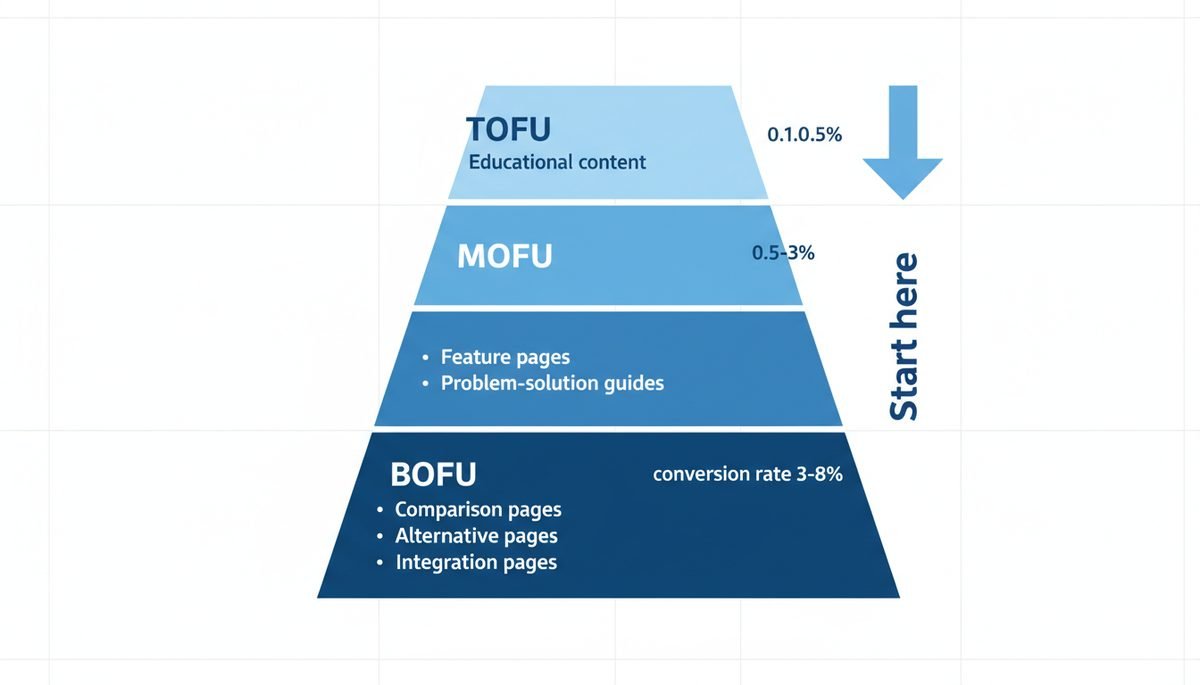
For a new site with limited time and no existing domain authority, bottom-of-funnel (BOFU) content is the right starting point. These are the pages that rank when someone is already evaluating solutions, and they convert at 5-10x the rate of awareness content.
The three BOFU content types every SaaS site should build first:
1. Comparison Pages: [Your Product] vs. [Competitor]
People comparing two products are minutes from making a decision. A well-built comparison page (honest, specific, and structured around the real differences) can rank for “[product A] vs [product B]” and capture buyers who are actively in the decision stage. You don’t even need to win every comparison. Some visitors will decide your competitor is better for their use case. That’s fine: you want qualified buyers, not every visitor.
2. Alternative Pages: “Best Alternatives to [Competitor]”
These pages exist to capture people who are unhappy with an existing tool and looking for something better. The target keyword is typically “[competitor name] alternatives” or “best [competitor name] alternatives.” If a dominant player in your category has any significant user base, this search exists. These pages tend to rank faster than most content types because intent is crystal clear and competition is often thin.
3. Integration Pages: [Your Product] + [Popular Tool]
Integration pages target users of adjacent tools who want to know if your product works with their existing stack. “Does [your tool] integrate with Slack?” is a question someone asks when they’re evaluating you. An integration page for each key connection in your stack doubles as an SEO asset.
Build these three page types before you write a single top-of-funnel blog post. They take less time to rank, convert better, and directly support revenue.
The 5 SaaS Content Types That Drive Organic Signups
Once your BOFU foundation is in place, you can work up the funnel. Here’s how the full SaaS content taxonomy works, in order of conversion potential:
| Content Type | Funnel Stage | Example Keyword | Conversion Rate | Time to Rank |
|---|---|---|---|---|
| Comparison pages | BOFU | “Notion vs. Coda” | High (4-8%) | 2-4 months |
| Alternative pages | BOFU | “Notion alternatives” | High (3-7%) | 2-5 months |
| Feature/use-case pages | MOFU | “project management for freelancers” | Medium (1-3%) | 3-6 months |
| Problem-solution guides | MOFU | “how to manage client projects” | Medium (0.5-2%) | 4-8 months |
| Educational content | TOFU | “what is project management” | Low (0.1-0.5%) | 6-12 months |
For a solo founder, we suggest sticking to the top three rows until you have 20+ pieces of content indexed. TOFU content has its place in a mature content strategy, but it’s a poor use of a one-person team’s writing time early on.
Keyword Research for SaaS: How to Find the Right Targets
Keyword research for SaaS isn’t about finding the highest volume keywords. It’s about finding keywords where your content can realistically rank and where ranking means something for revenue.
A practical framework for solo founders:
- List your competitors. Every competitor has a keyword gap you can exploit. Use a tool like Ahrefs or Semrush to find what keywords drive their traffic.
- Target keywords with KD (keyword difficulty) under 30 first. As a new domain, you won’t rank for high-competition keywords regardless of content quality. Find the pockets of low competition where you can get early wins.
- Filter by intent. Informational keywords (“what is X”) belong in late-stage content plans. Target navigational (“X vs Y”), commercial (“best X for Y”), and transactional (“X pricing”) keywords first.
- Check the SERP manually. A keyword with KD 40 might actually be winnable if the current results are thin forum threads and outdated posts. The data is a guide, not a verdict.
Technical SEO for SaaS Apps: The Short Checklist
Technical SEO isn’t glamorous, but a site with crawl problems won’t rank regardless of content quality. The good news: most SaaS marketing sites need the same basic foundation, and it’s not complicated to get right.
Run through this checklist once, then revisit quarterly:
- Permalink structure. If you’re on WordPress, make sure your URLs use /%postname%/ not the default date-based or index.php structure. Short, readable slugs rank better and are easier to manage.
- XML sitemap. Submit it to Google Search Console. Make sure all your important pages are in it and nothing is accidentally blocked by robots.txt.
- Core Web Vitals. Google’s page experience signals (LCP, FID, CLS) affect rankings. Run your site through PageSpeed Insights and fix whatever is flagged as “Poor.” For most SaaS marketing sites, image compression and removing unused JavaScript solves 80% of issues.
- Canonical tags. If your app creates duplicate URLs (filtered views, pagination, session IDs), canonical tags tell Google which version to index. Many SaaS apps leak thousands of near-duplicate URLs without realizing it.
- Schema markup. At minimum, add Article schema to blog posts and FAQPage schema to any page with question-and-answer content. This makes your content eligible for rich results in Google.
- HTTPS and security headers. Non-negotiable in 2026. Ensure all pages redirect from HTTP to HTTPS and that your SSL certificate is current.
A Note on Single-Page Apps and JavaScript Frameworks
If your marketing site is built with React, Vue, or another JavaScript framework, or if it’s a single-page app, you have an extra technical hurdle. Google can index JavaScript-rendered content, but it does so inconsistently and with a crawl delay. Server-side rendering (SSR) or static site generation (SSG) via Next.js, Nuxt, or a similar framework eliminates this problem entirely. If you’re rebuilding or starting fresh, choose a framework that supports SSR. Your rankings will thank you.
Link Building for Solo Founders (Without Cold Emailing 500 People)
Backlinks remain one of the most important ranking factors, and they’re also the hardest thing for a solo founder to build. The good news: you don’t need hundreds of links to rank for most SaaS SEO keywords. A handful of quality, contextually relevant links can move the needle significantly in a low-competition niche.
Three link-building approaches that work with limited time:
- Product integrations and partner listings. If your product integrates with other tools, reach out to get listed in their “integrations” or “partner” directories. These links are relevant, often dofollow, and require a single email to an existing business relationship.
- Original data and research. Publish a study, a benchmark report, or an original dataset related to your niche. Journalists, bloggers, and other SaaS companies will link to original data. Even a small survey (50-100 responses) with interesting findings generates links over time.
- Guest contributions on relevant publications. Pick two or three publications your target buyers read and pitch a bylined article. Not a promotional piece, but a genuinely useful one. One strong link from a respected industry publication is worth more than twenty from generic directories.
Realistic Timelines: What to Expect
The most common reason SaaS founders give up on SEO is that they expect results on an ads timeline. SEO doesn’t work that way. Here’s a realistic roadmap for a solo founder starting from scratch:
| Phase | Timeline | Focus | Expected Outcome |
|---|---|---|---|
| Foundation | Month 1-2 | Technical setup, BOFU pages, competitor research | Indexed site, 5-10 BOFU pages live |
| Content engine | Month 3-6 | 2 posts/week, mix of BOFU and MOFU, first links | First page-2 rankings, early organic traffic |
| Compounding | Month 6-12 | Refresh early content, add TOFU, build internal links | Page-1 rankings for target keywords, consistent signups from organic |
| Scaling | Month 12+ | Programmatic content, link campaigns, competitor gaps | Organic becomes a reliable, growing acquisition channel |
Two posts per week is a realistic cadence for a solo founder writing their own content. If writing isn’t your strength, two high-quality posts per month beats ten mediocre ones: quality of content matters more than cadence, especially on a new domain.
Content Clusters: How to Structure Your SaaS Site for Long-Term Growth
Random, disconnected blog posts don’t compound well. A content cluster strategy, where a central pillar page links out to a series of related supporting articles, tells Google that you’re an authority on a topic, not just a site that published one article about it.
For a SaaS site, a cluster might look like this:
- Pillar page: “SEO for SaaS: Complete Guide” (2,000-4,000 words, targets broad head term)
- Supporting posts: “SaaS keyword research,” “BOFU content for SaaS,” “technical SEO for SaaS apps,” “SaaS link building,” “SaaS content types”, each targeting a specific long-tail variation
Each supporting post links back to the pillar. The pillar links out to each supporting post. This internal linking structure passes authority, keeps readers on the site longer, and creates a tight topical footprint that search engines reward.
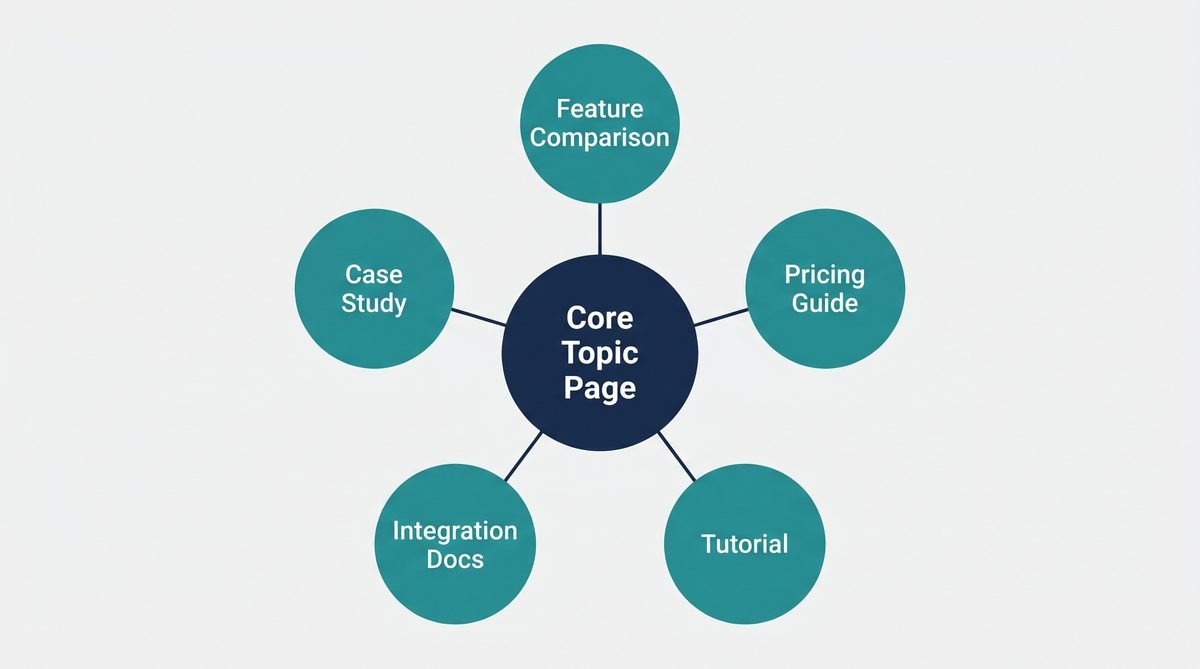
For a solo founder, we suggest building one complete cluster before spreading out into new topics. Going wide with five disconnected topics produces weaker results than going deep on one area first. Once your first cluster is ranking, use those rankings to bootstrap the next one.
Programmatic SEO: The Solo Founder’s Scaling Trick
Programmatic SEO is the practice of generating large volumes of pages automatically from structured data, rather than writing each one by hand. For SaaS companies, it’s one of the most powerful long-term strategies available, and it’s more accessible than most founders think.
Examples of programmatic SEO in action:
- A project management tool that creates a landing page for every “[your tool] for [industry]” combination, “project management for law firms,” “project management for marketing agencies,” and so on
- An integration directory where every “[your tool] + [partner tool]” pair gets its own page
- A templates library where each individual template has its own SEO-optimized page
The prerequisite is having structured data to work from, a list of industries, a catalog of integrations, or a set of templates. If you have that, a developer can spin up hundreds of pages with a consistent template in a day. Each page targets a long-tail keyword your hand-written content would never reach.
Programmatic SEO isn’t a shortcut. Thin, low-value programmatic pages get filtered by Google. The standard for each generated page should be: does this page genuinely answer the searcher’s question better than what’s currently ranking? If yes, build it. If not, don’t.
Quick Wins for Week One
If you’re just starting out and want to make the most impact in the first week, focus here:
- Set up Google Search Console and submit your sitemap. This is the single most important SEO action you can take. You need GSC to understand what’s working and what isn’t. Do this before anything else.
- Fix your permalink structure. If your WordPress site is using date-based or index.php URLs, change it to /%postname%/ today. This one change improves every URL on the site and every post you publish going forward.
- Write your first comparison page. Pick your most direct competitor, write an honest 1,000-word comparison, and publish it. This is the highest-ROI piece of content you can create on a new SaaS site.
- Install an SEO plugin. On WordPress, Yoast SEO or AIOSEO gets your title tags, meta descriptions, and schema in shape in under an hour. On other platforms, make sure you can edit these fields per page.
- Run your site through PageSpeed Insights. Fix anything flagged as “Poor” under Core Web Vitals before you start publishing. A slow site is a drag on every piece of content you ever publish.
Measuring SaaS SEO: What Actually Matters
Don’t get distracted by vanity metrics. A SaaS SEO program should be measured by two things: organic signups and keyword position movement for target terms.
Set up Google Analytics 4 with conversion tracking on your signup or free trial CTA. Connect Google Search Console to monitor impressions, clicks, and which queries are driving traffic. Review both monthly. Track your BOFU page positions for their target keywords weekly. Movement there is the earliest signal that your program is working.
Skip domain authority scores and traffic estimates from third-party tools in your early stages. They lag reality by months and can be misleading for new domains. Trust GSC data, it’s coming directly from Google.
Frequently Asked Questions
How long does SaaS SEO take to show results?
Most SaaS companies see their first meaningful organic traffic between months 3-6, assuming consistent content publishing and basic technical SEO in place. Page-1 rankings for target keywords typically arrive between months 6-12 for low-to-medium competition terms. High-competition terms can take 12-24 months. The compounding nature of SEO means growth accelerates over time.
Should a solo founder do SEO themselves or hire an agency?
In the early stages, before product-market fit and before you have a repeatable acquisition model, we suggest doing SEO yourself. Agencies are expensive, and the feedback loop between writing content and seeing what resonates is valuable founder learning. Once you have 30-50 pieces of content indexed, a clear keyword strategy, and the budget to scale, an agency or fractional SEO can accelerate results. Don’t hire an agency to figure out your SEO strategy, that’s your job.
What’s the most important SEO page type for a new SaaS?
Comparison and alternative pages. They target buyers who are already evaluating solutions, they convert at 3-8%, and they’re often under-served in niche SaaS categories. A well-written “[Your Product] vs. [Competitor]” page can rank within 3-4 months and directly drive trial signups.
Does SEO work for B2B SaaS with a small total addressable market?
Yes, often better than for consumer products. A niche B2B SaaS with 500 ideal customers per month searching for solutions needs far fewer rankings to matter than a B2C product. Low-volume keywords with high commercial intent are easier to rank for and more valuable per visitor than high-volume informational terms.
How does AI affect SaaS SEO in 2026?
AI Overviews in Google are changing how informational queries get answered, particularly for simple how-to and definition searches. The impact on BOFU and commercial queries, comparisons, alternatives, pricing, reviews, has been minimal. For SaaS companies, this reinforces the BOFU-first strategy: build content targeting buyers in decision mode, where AI summaries are less likely to intercept the click.
RELATED POSTS
View all

Link Building Strategies: The Complete Guide for App Developers and SaaS Founders (2026)
July 1, 2026 | by Ian Adair